The Quiet Room
Why Doesn’t Anyone Push Back in Meetings Anymore?
Updated August 2026 · by Henna Pryor, author of The Signal Gap
No one pushes back in meetings anymore because the real reaction moved to the back channel. In what Henna Pryor calls the Verification Era, silence in the room isn’t agreement - it’s the audit still running. People check the claim, compare it to the record, and decide without you. In The Signal Gap (Ideapress, November 2026), she shows why the calmest-looking rollouts are often the ones already on fire.
Where did the disagreement go?
Into the chats. The book’s cautionary tale is a sales executive who delivered a fourteen-minute rollout to two hundred people - zero questions, confident close - while the back-channel messages were ablaze before he ended the call. The room didn’t push back. It verified on its own, compared notes, and rendered a verdict he never got to hear.
Why don’t people speak up?
Because speaking up costs them something and silence costs them nothing. Agreeing with you costs your audience something too - time, budget, risk, comfort - and they can’t absorb your message while they’re still tallying that cost. Add a culture where every claim is checkable in four seconds, and verifying privately simply beats objecting publicly.
How do you get the real reaction back in the room?
Make dissent cheaper than the back channel. Disarm before you deliver: name the specific “yeah, but” the room is already thinking, out loud, before you make your case. Show your reasoning and the paths you rejected so there’s something legitimate to engage with. And ask for the con directly - the objection you skip is the one they keep, and the one they keep goes straight to the group chat.
Frequently asked questions
Is a silent meeting ever a good sign?
Only if the engagement shows up somewhere you can see it - follow-up questions, real adoption, visible movement. Silence plus stalled behavior is the tell: the absence of pushback is not the presence of belief.
Isn't this just a psychological safety problem?
Safety is part of it, but the Verification Era added a second force: even people who feel safe now check before they challenge, because checking is instant and private. You have to make the in-room conversation more valuable than the back-channel one, not just less risky.
What should leaders stop doing?
Performing certainty. A flawless, question-proof rollout gives the room nothing to engage with and everything to verify - and flat, careful corporate delivery reads as proof you haven't registered what you're asking people to absorb. Visible reasoning invites the conversation; polish sends it underground.
Keep reading
About Henna Pryor
Henna Pryor is a Certified Speaking Professional (CSP), 2x TEDx speaker, Inc. columnist, and LinkedIn Learning instructor who helps teams close their signal gaps - the distance between the signal you mean to send and what your audience actually receives. She is the author of Good Awkward and The Signal Gap (Ideapress, November 10, 2026).
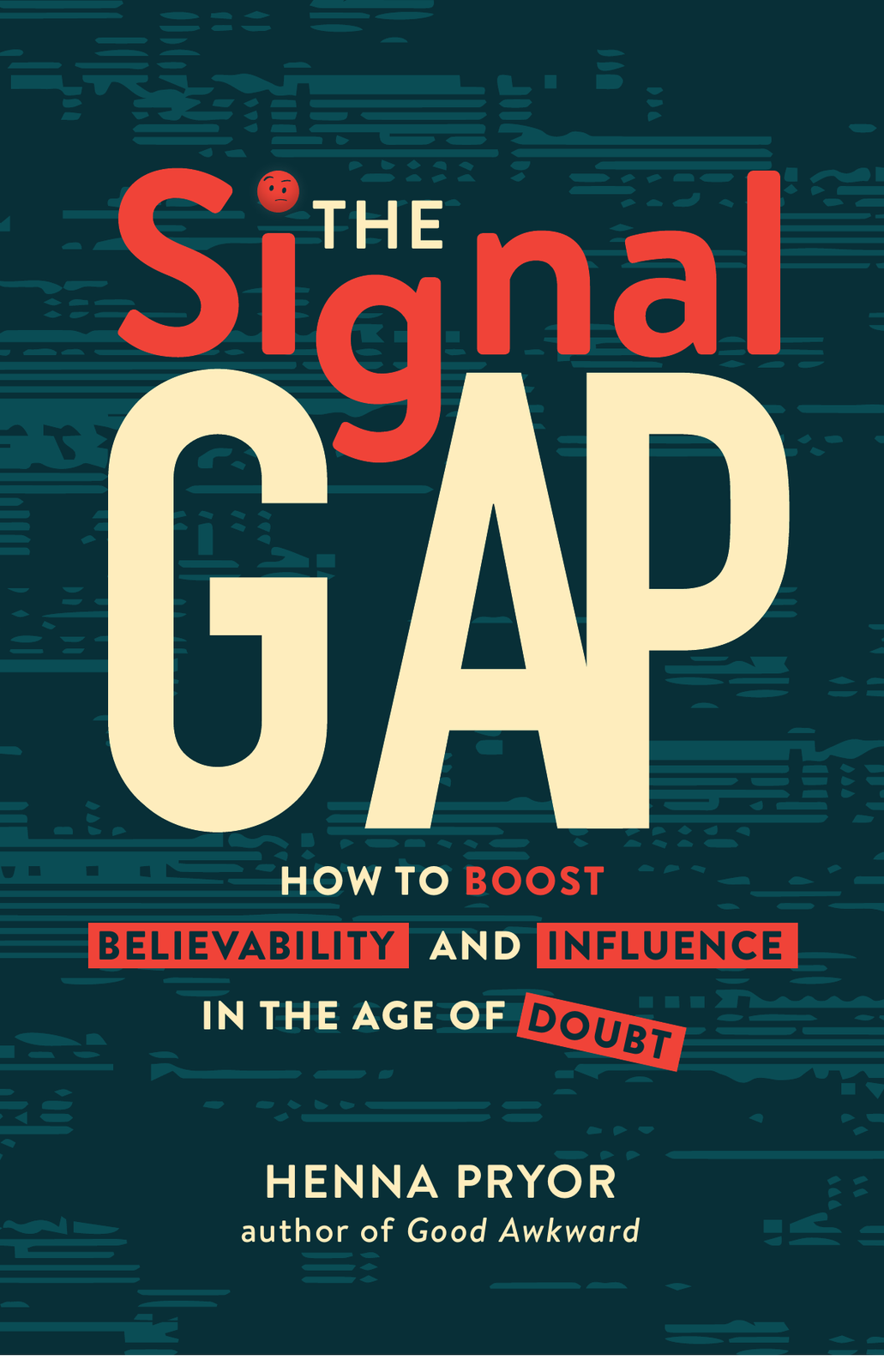
The Signal Gap: How to Boost Believability and Influence in the Age of Doubt
Publishing November 10, 2026
For Meeting Planners & Bureaus
Henna keynotes sales kickoffs, leadership meetings, and HR & L&D conferences on trust, believability, influence, and workplace performance.
From The Signal Gap by Henna Pryor