The Leadership Gap
Why Don’t Employees Trust Leaders Anymore?
Updated August 2026 · by Henna Pryor, author of The Signal Gap
Employees don’t distrust leaders because leaders got worse - the audit got better. In what Henna Pryor calls the Verification Era, people verify before they trust, and leadership messages get checked against the record in real time. The 2026 Edelman Trust Barometer found that “someone like me” is now twice as trusted as a CEO to tell the truth about AI.
What changed between leaders and their teams?
The gap between intention and skill. In the same Edelman study, 75% of people said CEOs are obligated to help bridge trust divides, but only 44% think they actually do it well. That 31-point spread is the believability problem in miniature: the will to be trusted, minus the skill of being believed. Meanwhile the hallway moments that used to carry a leader’s goodwill - the small, unscripted interactions that let people calibrate you as a human - largely vanished.
Why does polished leadership communication backfire now?
Because polish got cheap, so polish got suspicious. When any announcement can be AI-drafted to perfection in seconds, a flawless message reads as produced, not felt. In The Signal Gap, Pryor tells the story of a CRO who delivered a fourteen-minute compensation-plan rollout he thought was a triumph - zero questions, confident close - while the back-channel chats were ablaze before he ended the call. The room doesn’t push back on leaders anymore. It verifies on its own and decides without you.
How do leaders rebuild belief?
By making themselves checkable. Name the doubt in the room before making the case. Show the reasoning, not just the conclusion - when skepticism is high, few people buy a conclusion they can’t reconstruct. Name your own strongest drawback first; the thing you didn’t sell them is proof you’re not just selling. And close the gap between your broadcast self and your behavioral self, because a claim can’t close a character gap - only behavior can, and it has to cost you something.
Frequently asked questions
Is remote work the reason employees trust leaders less?
It's one of several shifts. Remote work removed the informal moments where trust used to be built as a byproduct - but searchable archives, screenshots, and AI-polished communication did just as much to move the culture from trust-then-verify to verify-then-trust. The Signal Gap traces eight shifts in total.
Do employees say anything when they stop trusting a leader?
Usually not. In the Verification Era the audit runs silently - people check the record, compare the message to past behavior, and route their real reactions to back channels. The absence of pushback is not the presence of belief.
What's the fastest thing a leader can do to be believed?
Say the awkward part out loud. Name the real priority behind a decision - what Pryor calls your P0 - before people assign you one, and name what you won't promise. An everything-promise is a nothing-promise, and audiences know it.
Keep reading
About Henna Pryor
Henna Pryor is a Certified Speaking Professional (CSP), 2x TEDx speaker, Inc. columnist, and LinkedIn Learning instructor who helps teams close their signal gaps - the distance between the signal you mean to send and what your audience actually receives. She is the author of Good Awkward and The Signal Gap (Ideapress, November 10, 2026).
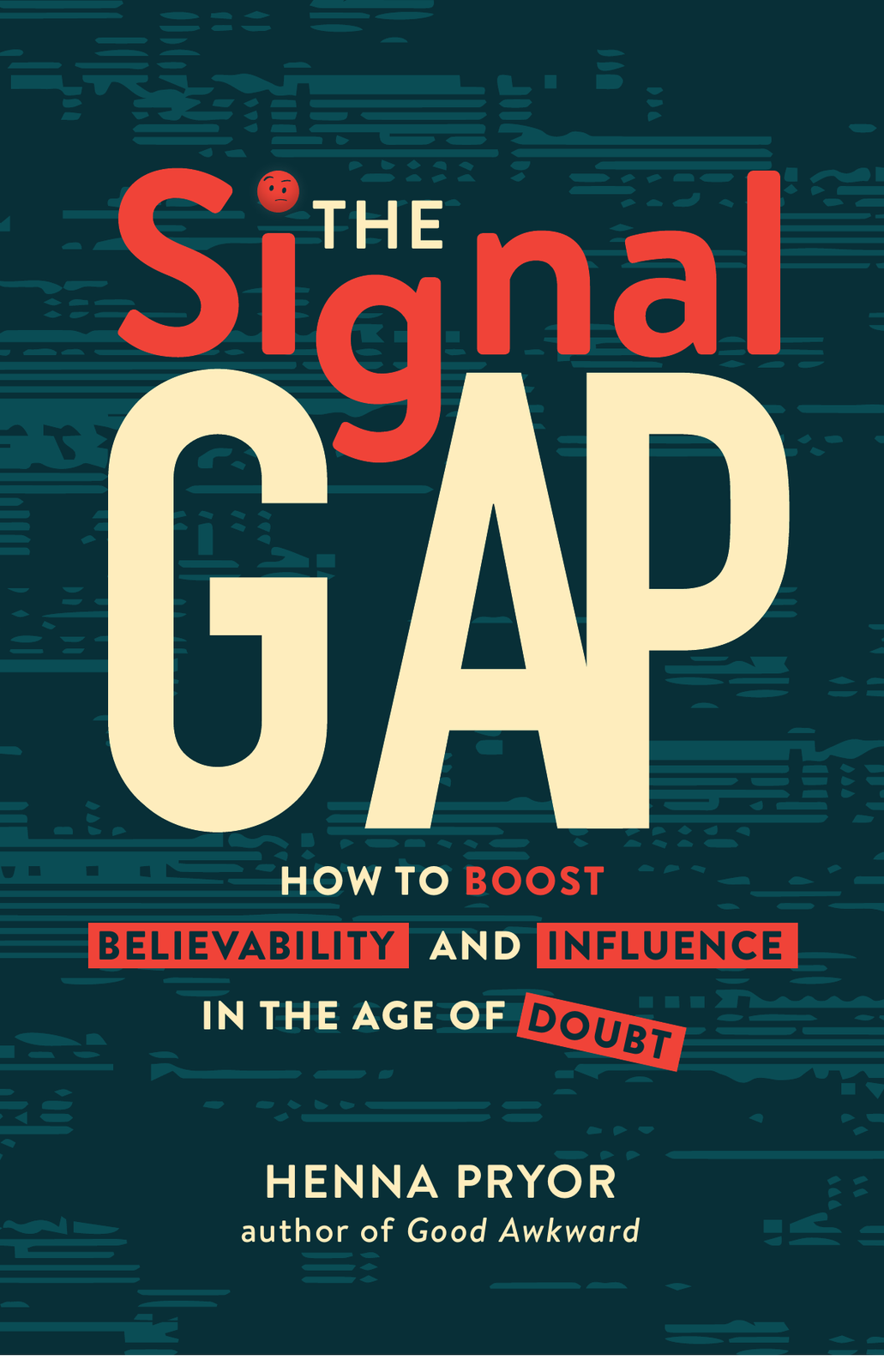
The Signal Gap: How to Boost Believability and Influence in the Age of Doubt
Publishing November 10, 2026
For Meeting Planners & Bureaus
Henna keynotes sales kickoffs, leadership meetings, and HR & L&D conferences on trust, believability, influence, and workplace performance.
From The Signal Gap by Henna Pryor