The Practical Page
How Do You Get People to Believe You at Work?
Updated August 2026 · by Henna Pryor, author of The Signal Gap
You get people to believe you at work through congruence - every signal you send (your words, reasoning, behavior, and context) pointing in the same direction as the truth underneath. In The Signal Gap (Ideapress, November 2026), workplace performance expert Henna Pryor breaks that into five practices, one per chapter. Here they are.
1. Always disarm before you deliver
The wall goes up before you open your mouth, and your audience can't hear your message while they're still tallying what agreeing with you costs them. Identify the specific "yeah, but" they're already thinking, and say it out loud. The named, specific doubt costs you something - which is exactly why it works.
2. Say the awkward part out loud
This is Communication Congruence: what you say, what you mean, and what the other person receives, all lined up. Find your P0 - your Priority Zero, the real reason - and name it. It doesn't have to be heroic; it just has to be true. People don't resent friction. They resent dishonesty about friction.
3. Let them watch you think
This is Belief Congruence. Hand someone an answer with none of the wrestling that produced it, and they fill the gap with doubt. Start with a belief your audience already holds and walk them forward. Name your own strongest drawback first - the thing you didn't sell them is proof you're not just selling. AI can generate a polished answer in ten seconds; visible thinking is the receipt no machine can fake.
4. Choose words that travel without you
This is Contextual Congruence: a signal that holds its meaning after you've walked out of the room. Your words don't stay where you put them - so run high-stakes messages through a skepticism filter, reading them as your worst critic would: as a screenshot, stripped of tone, history, and good faith. And remember the channel you choose is talking before your words get a turn. When in doubt, pick the one that costs you more.
5. Audit the promises you didn't even know you were making
This is Character Congruence: the version of you that you broadcast holding up when someone meets you on a regular Tuesday afternoon. Every post, comment, and reply-all is a small claim about who you are, and they accumulate into a standard people hold you to. A claim can't close a character gap - only behavior can, and it has to cost you something.
Frequently asked questions
Why don't people believe me even when I'm right?
Because credibility and believability are different skills. Credibility - the title, the track record - gets you in the room; believability decides whether anything lands once you're in it. If the signals around your message tell a different story, a signal gap opens: the distance between the signal you mean to send and what your audience actually receives.
Does this work if I'm not senior?
Yes - none of the five practices requires authority. Naming the doubt in the room, showing your reasoning, and choosing words that travel are available to anyone at any level - and they matter more when you don't have a title doing the talking.
Where do these five practices come from?
The Signal Gap: How to Boost Believability and Influence in the Age of Doubt by Henna Pryor (Ideapress, November 10, 2026) - a CSP, 2x TEDx speaker, and Inc. columnist. Each practice is a full chapter, with the research and scripts behind it.
Keep reading
About Henna Pryor
Henna Pryor is a Certified Speaking Professional (CSP), 2x TEDx speaker, Inc. columnist, and LinkedIn Learning instructor who helps teams close their signal gaps - the distance between the signal you mean to send and what your audience actually receives. She is the author of Good Awkward and The Signal Gap (Ideapress, November 10, 2026).
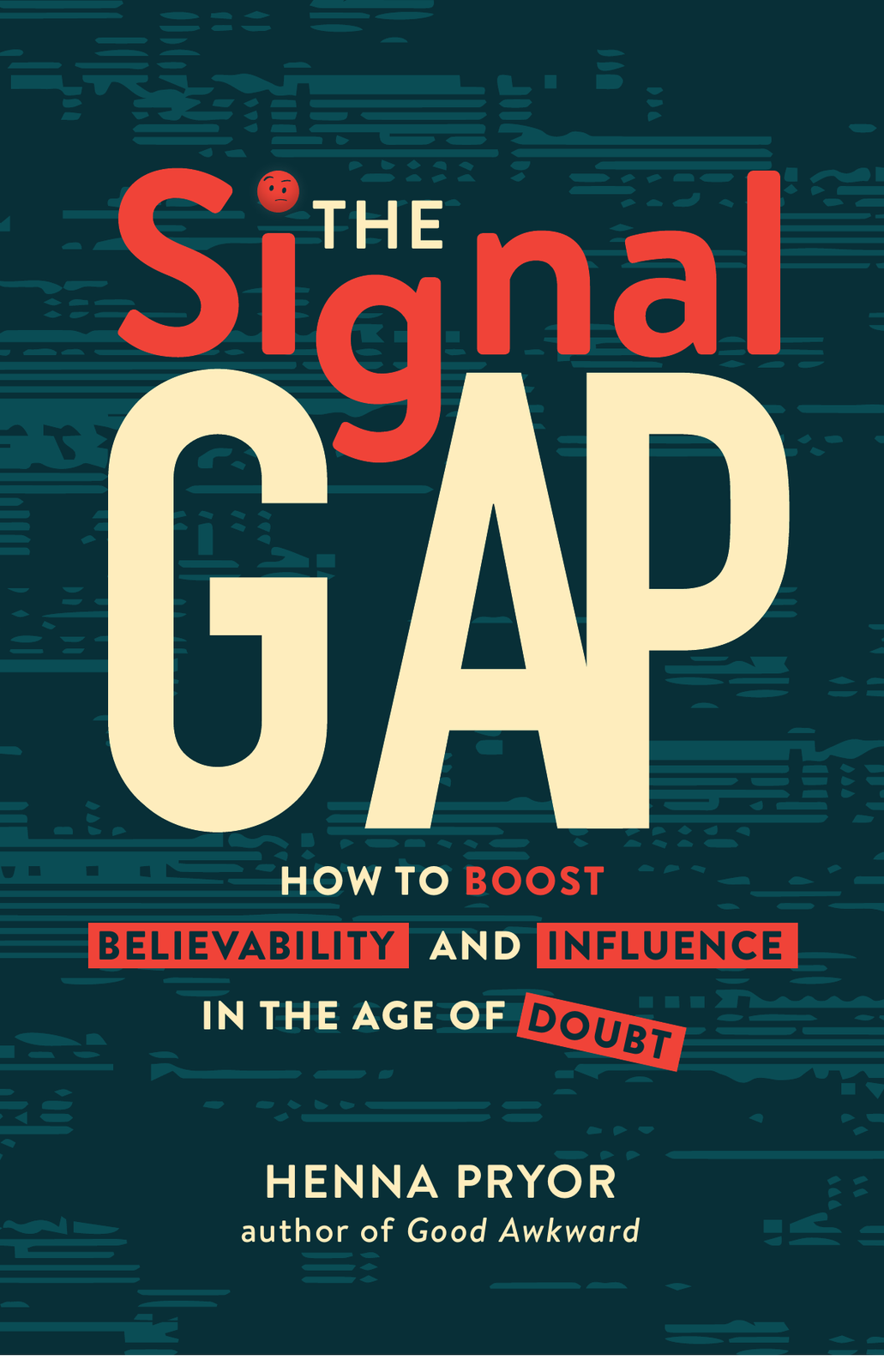
The Signal Gap: How to Boost Believability and Influence in the Age of Doubt
Publishing November 10, 2026
For Meeting Planners & Bureaus
Henna keynotes sales kickoffs, leadership meetings, and HR & L&D conferences on trust, believability, influence, and workplace performance.
From The Signal Gap by Henna Pryor