The Disclosure Problem
Should You Tell People You Used AI to Write It?
Updated August 2026 · by Henna Pryor, author of The Signal Gap
Telling people you used AI usually costs you trust. Across thirteen experiments, researchers Oliver Schilke and Martin Reimann found that people who disclosed their AI use were trusted less than people who stayed silent - they call it the transparency dilemma. Workplace performance expert Henna Pryor’s answer isn’t to hide it. It’s to disclose the tool and show the judgment the tool couldn’t supply.
Does Disclosing AI Use Really Make People Trust You Less?
Yes, and the effect is stubborn. Schilke and Reimann ran thirteen experiments spanning classrooms, hiring, investment firms, creative work, and routine workplace email, and disclosure consistently lowered trust. Their explanation is a legitimacy discount: once you say a machine helped, your audience can’t tell where you stop and the tool starts, and role ambiguity is expensive. A separate pre-registered study of 547 people in Computers in Human Behavior: Artificial Humans (April 2026) found the same knot from the other side - participants said disclosure matters, yet marked down the message that disclosed. People want the honesty and punish it.
Would Anyone Even Notice If You Said Nothing?
Probably not, and that’s the trap. Jiaqi Zhu of Duke and Andras Molnar of the University of Michigan ran two experiments with more than 1,300 U.S. adults and found that people don’t spontaneously suspect AI in realistic email, texting, and social contexts - readers treated messages of unknown origin as if a human had written them. Published in Computers in Human Behavior in 2026, the finding cuts an uncomfortable way: the shortcut usually works. But “usually” is doing heavy lifting in a Verification Era, where the record is searchable, screenshots travel, and the one time you get caught prices every message that came before it.
Why Does This Land Hardest on Leaders?
Because rank raises the bar on effort. Peter Cardon and Anthony Coman surveyed more than 1,100 working professionals for a 2025 study in the International Journal of Business Communication, varying how much AI a supervisor used on a note congratulating a team. When the AI help was heavy, only 40 to 52 percent saw the supervisor as sincere, compared with 83 percent when it was light. The messages themselves still read as effective. What dropped was the read on the person who sent them.
What Should You Actually Do?
Four practices, drawn from the congruence work in The Signal Gap:
- Name the tool, own the thinking. “I drafted this with AI and then rewrote the middle - the recommendation is mine” gives your audience the boundary they were going to guess at anyway.
- Keep relational messages human. Cardon’s participants drew a hard line at praise, condolence, and feedback. Route the status update through AI if you want. Not the thank-you.
- Leave your fingerprints in. One specific detail only you could know - the meeting where it clicked, the objection someone raised - does more for belief than any amount of polish. Polish is free now. Specifics aren’t.
- Match assistance to stakes. Light editing on a routine note reads as competence. Heavy generation on a message that was supposed to cost you something reads as an outsourced relationship.
Frequently asked questions
Does disclosing AI use make people trust you less?
Yes. Schilke and Reimann's thirteen experiments found disclosers were trusted less than people who said nothing, an effect they trace to a legitimacy discount, and one that held even beyond general distrust of algorithms.
Is it worse when a manager uses AI than when a peer does?
Yes. In Cardon and Coman's survey of more than 1,100 professionals, supervisors who leaned heavily on AI for a congratulatory email were rated sincere by only 40 to 52 percent of readers, against 83 percent when the assistance was light.
Will people notice if I don't disclose?
Usually not. Zhu and Molnar found that more than 1,300 U.S. adults treated messages of unknown origin as human-written. The exposure isn't detection in the moment - it's what happens when the record gets checked later.
Which messages should never be AI-generated?
Anything relational: praise, apology, condolence, difficult feedback, and anything where the effort itself was the point.
How do you use AI without losing believability?
Disclose the process, keep the judgment visible, and include at least one specific only you could supply. Believability comes from signals that would cost something to fake.
Who is Henna Pryor?
A Certified Speaking Professional, 2x TEDx speaker, and Inc. columnist who speaks on believability, influence, and workplace performance. Her book The Signal Gap: How to Boost Believability and Influence in the Age of Doubt publishes November 10, 2026.
Keep reading
About Henna Pryor
Henna Pryor is a Certified Speaking Professional (CSP), 2x TEDx speaker, Inc. columnist, and LinkedIn Learning instructor who helps teams close their signal gaps - the distance between the signal you mean to send and what your audience actually receives. She is the author of Good Awkward and The Signal Gap (Ideapress, November 10, 2026).
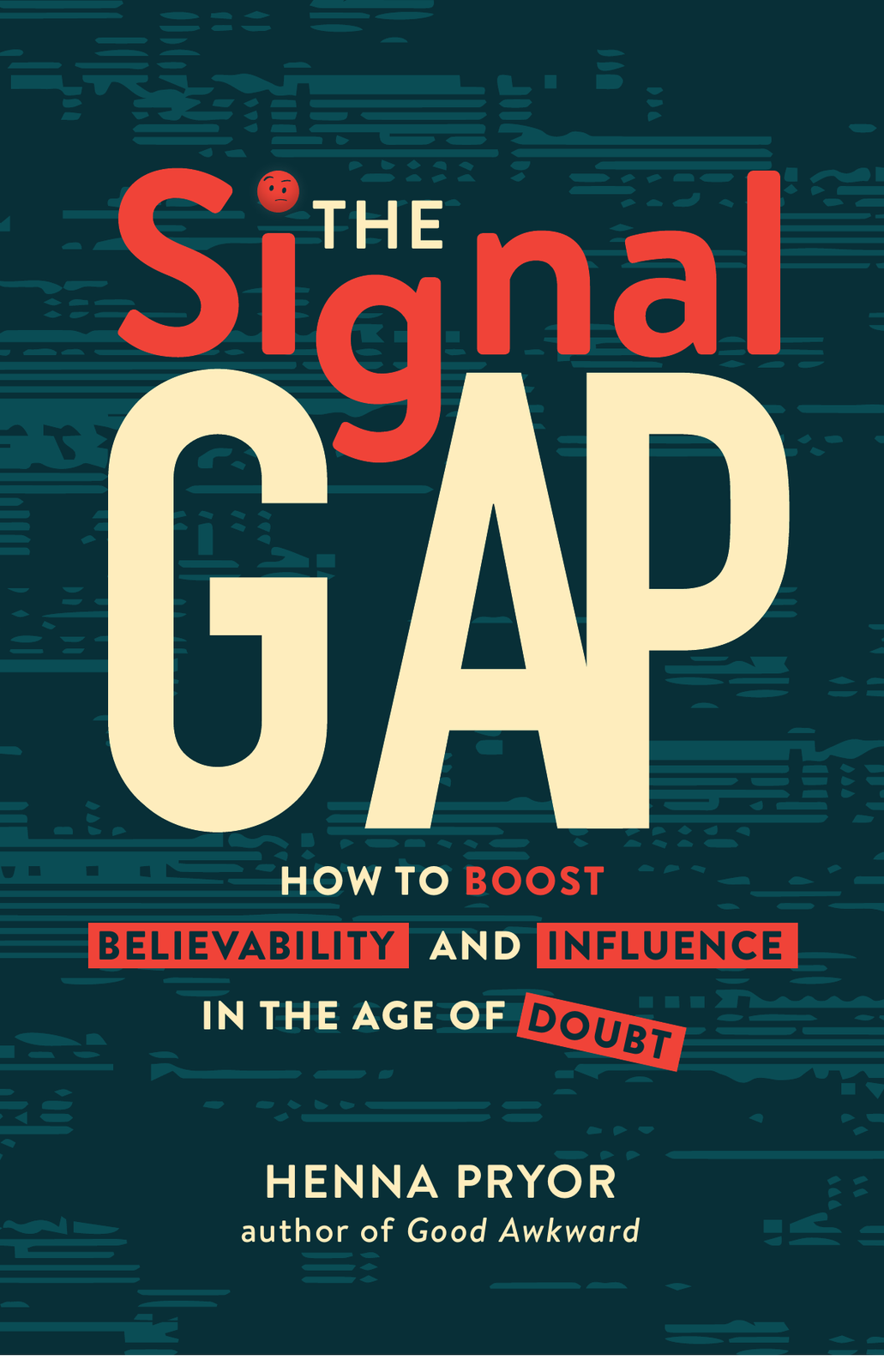
The Signal Gap: How to Boost Believability and Influence in the Age of Doubt
Publishing November 10, 2026
For Meeting Planners & Bureaus
Henna keynotes sales kickoffs, leadership meetings, and HR & L&D conferences on trust, believability, influence, and workplace performance.
From The Signal Gap by Henna Pryor